Business Handshake Vector Clipart
As a designer who spends half my day staring at stitch lines and the other half worrying about client deadlines, I don’t just look at a design file; I look at its potential. When I first pulled Business Handshake Vector Clipart into my digitizing software, I wasn’t looking for a generic icon. I was looking for something that could anchor a professional yet approachable brand identity for a small business owner launching a new consultancy or a boutique offering corporate gifting services.
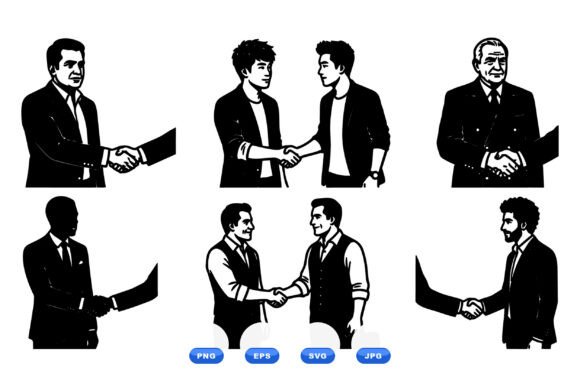
The product description highlights a retro silhouette vector set depicting men in formal attire shaking hands. At first glance, this sounds like standard clipart. But when you strip away the color and focus on the negative space and the bold outlines of a silhouette, you realize this is actually a very strong candidate for machine embroidery. The simplicity is its greatest strength. In the world of embroidery, complexity is often the enemy of clarity. A handshake, rendered as a solid shape with minimal internal detail, translates beautifully to thread. It doesn’t get lost in the fabric grain, and it holds up well against the wear and tear of daily use.
First Impressions and Visual Personality
The mood of this design is immediate: trust, agreement, and partnership. Because it relies on a retro aesthetic, it avoids feeling sterile or overly corporate. There is a warmth to the silhouette style that makes it feel timeless rather than trendy. This is crucial for handmade products because you want your customers to feel like they are buying something with character, not just a mass-produced logo.
I visualized this design primarily as an embroidered patch or a direct-to-garment application on high-quality cotton. The clean lines of the vector translate naturally into a satin stitch border, which gives the design a crisp, finished edge. Inside the silhouette, if you choose to fill it, a dense fill stitch would hold its shape perfectly. However, the true beauty lies in its versatility. It can be a standalone statement piece or part of a larger collage of business-themed icons.
Real-World Application: From Screen to Stitch
Let’s talk about how this plays out in actual production scenarios. Imagine you are an Etsy seller preparing a line of custom tote bags for entrepreneurs. You have a customer who wants a subtle but professional logo for their side hustle. Placing a detailed photograph-style image on canvas might look muddy after washing. But Business Handshake Vector Clipart, with its bold contrast, will pop against a natural linen or black canvas tote.
I also see this working exceptionally well for corporate gifts. Picture a sweatshirt embroidery project where a company wants to commemorate a merger or a successful quarter. A handshake motif is universally understood. It conveys success without being aggressive. If you are creating personalized gifts for weddings or anniversaries—perhaps for a couple who runs a business together—this design offers a sophisticated touch that feels earned rather than decorative.
For craft fair vendors, this design is a low-risk, high-reward option. It works on aprons for food bloggers who are building a brand, on tea towels for home chefs, and even on baby onesies for parents who want to send a "little entrepreneur" message. The retro vibe ensures it appeals to millennial and Gen Z buyers who appreciate vintage aesthetics, expanding your market reach beyond traditional corporate clients.
Where Caution Is Required
While the design is robust, no embroidery project is without its pitfalls. Here is where you need to apply your designer’s eye:
- Hoop Size Constraints: While the vector itself is scalable, remember that smaller hoop sizes limit your ability to add intricate details. If you scale this down too much for a tiny cap front or a delicate baby item, the handshake may lose its definition. Test the minimum viable size before committing to a run.
- Fabric Texture: This design thrives on smooth surfaces. On heavily textured fabrics like chunky knit sweaters or raw denim, the edges of the satin stitch might struggle to lay flat. For these materials, consider using an applique design approach, where you cut the silhouette from contrasting fabric and stitch around the edge. This adds dimension and solves stability issues.
- Dark Fabrics: If you are stitching this on dark fabric, thread choice becomes critical. A single-color white or gold outline will work, but a multi-color fill might require excessive underlay stitches, leading to puckering. Always check your stabilizer support. A cut-away stabilizer is non-negotiable for garments that will undergo frequent washing, such as caps and aprons.
- Curved Surfaces: Embroidering on the curved crown of a hat requires careful tension adjustment. The handshake motif is relatively compact, which helps, but ensure your digitizer has accounted for the curve so the figures don’t appear distorted.
Impact on Brand Value and Customer Trust
In the handmade market, presentation is everything. A clean, well-executed embroidery design signals quality. When a customer sees a sharp handshake motif on a premium leather patch or a structured tote bag, they perceive higher value. It suggests that the maker cares about precision. This is particularly important for commercial embroidery projects where you are selling B2B services. A client reviewing your portfolio will instantly recognize the professionalism in a design that handles negative space effectively.
Furthermore, the "retro" aspect adds a layer of nostalgia that resonates emotionally. People buy handmade goods for the story and the feeling, not just the utility. This design evokes a sense of old-school reliability. It builds trust with the buyer before they even read your product description. For digital product sellers, using this as a printable mockup preview allows you to showcase how versatile the asset is, appealing to other designers who need reliable design assets for their own projects.
Practical Designer Notes for Execution
Before you hit the start button on your machine, there are several steps I always recommend to ensure a flawless finished product:
- Test on Scrap Fabric: Never assume a design will behave perfectly on your final material. Run a test stitch-out on the exact fabric type you plan to use. Check for any gaps in the satin stitch or areas where the fill stitch might show the backing.
- Review Stitch Density: High-density designs can cause fabric distortion, especially on lightweight materials. Ensure the stitch density is appropriate for the weight of your fabric. If the design feels too heavy, consider reducing the density or switching to a running stitch for certain elements.
- Thread Color Contrast: Experiment with different thread colors. A metallic thread might elevate the retro feel, while a matte cotton thread keeps it grounded. Check how the colors interact with your fabric texture. Sometimes, a monochromatic look is more elegant than a multi-colored one.
- Black and White Mockups: View your design in grayscale. This helps you assess the balance of light and dark areas. If the design looks muddy in black and white, it will likely look muddy in color as well.
- Confirm Licensing: Since this is a vector clipart product, verify the licensing terms carefully. Are you allowed to sell finished physical items? Can you use it in digital embroidery files for resale? Clarifying this protects your craft business from legal issues.
In conclusion, Business Handshake Vector Clipart is more than just a simple graphic. It is a versatile tool for any embroiderer looking to create meaningful, professional-grade products. Whether you are making a personalized gift for a friend or building a brand for your small shop, this design offers the clarity, style, and emotional resonance needed to succeed. Treat it with respect, test it thoroughly, and let the quality of your stitching speak for itself.